Drey’s Take on Gifty’s Valley of Tears in “Transcendent Kingdom”
It’s a sunny day in October. I have just ended my walk, the first after a few weeks of intense studying. I am in my safe space–a bookstore. I walk through the rows of books and release the tension of MCAT prep and job hunting while retaining the pressures of the uncertainty of my life decisions. I use money I don’t have to buy a book as a reward for taking the exam that has brought many tears and sleepless nights. I continue to wander the bookstore while the stack of books under my armpit grows bigger than the allotted book I promised myself.
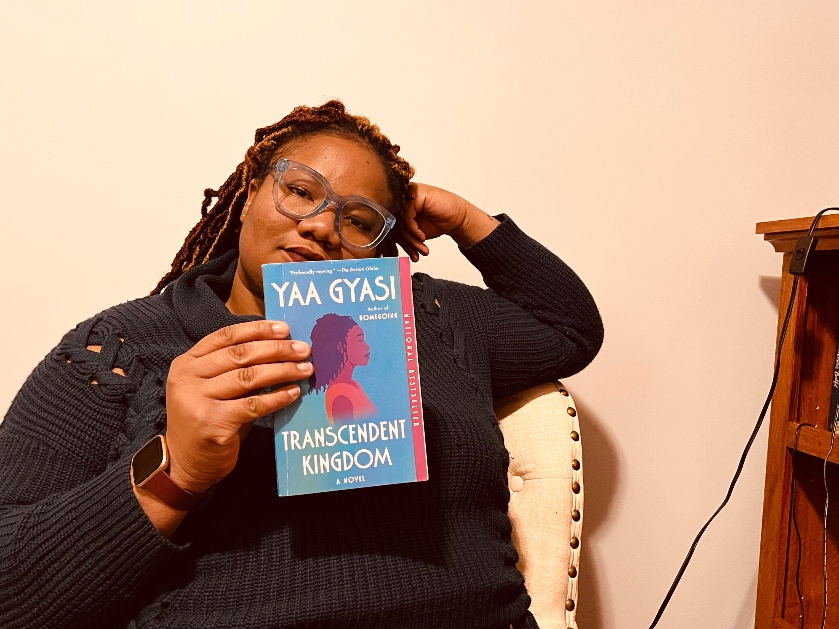
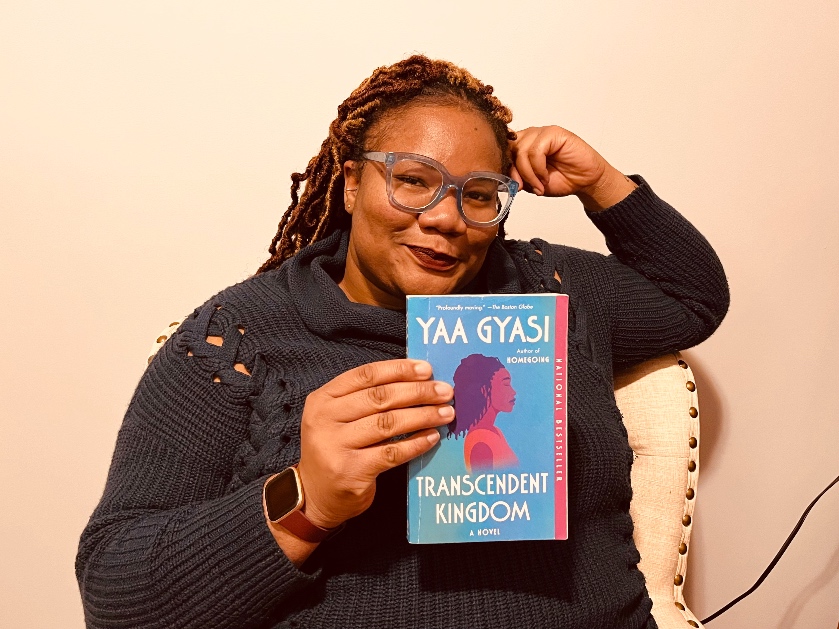
I fell in love with Yaa Gyasi’s writing style after reading “Homegoing” last year. So naturally, I’ve been waiting for the time to pick up “Transcendent Kingdom.” At the time I didn’t know the blurb of the book; I just knew that it was Gyasi’s new book. I eventually settle on buying 4 books (3 books more than intended), including “Transcendent Kingdom.” I find a corner in the bookstore’s cafe and open to the first page of Gyasi’s work, still with no knowledge of what I have just signed myself up for. However, as I read, I realize that this may not be the light reading I had in mind. By the end of chapter 6, Gifty drops a bombshell that requires me to close the book and leave the bookstore for fear of crying in public.
Gifty’s Valley of Tears
“Transcendent Kingdom” follows the journey and prayer journal entries of sixth-year neuroscience Ph.D. candidate Gifty. Gifty has been dealt quite a hand in life. She is a second-generation immigrant from Ghana. She used to be in a family of four; however, by the start of the novel, she is in a family of two. Her father could not deal with the US-American racism that followed simply because he was a tall dark African man. He struggled to find work and the work he eventually found emasculated and dehumanized him. He eventually returned to Ghana and left his wife, daughter, and son in Alabama. Nana, her brother and first-born, was Gifty’s and her mother’s pride and joy. He had athletic prodigious gifts. He initially started off with soccer but left the sport when their father abandoned him. He eventually finds his way to basketball where he hurts himself during a low-stakes game. He is prescribed opioids and quickly becomes addicted. He eventually turns to heroin and dies from an overdose at the age of 18. Gifty’s mother goes into a deep depressive state and attempts to commit suicide. Gifty is sent to Ghana during that summer so that her mother may get help.
This is the backdrop to Gifty’s crisis with God and religion. Gifty grew up in a very Christian home and had a big conversion experience while she was younger that left her self-righteous and faithful. In the Catholic Church, we believe that someone can have multiple conversion experiences. A conversion is simply something that calls you deeper into your relationship with the triune God while allowing God to go down the staircase of your heart. Child Gifty writes letters to God in her journal. She treats God like her best friend. She creates code names for the people in her life and tells Him about the things that are happening in her life. Though homegirl is self-righteous, she has the child-like faith that Jesus calls us to in Matthew 18:3. However, when pain offers no reason for existence, our relationships with a personal and good God are the first things we question.
Gifty throws herself into academics and finds herself at elite universities: first at Harvard for undergrad and Stanford Med for her Ph.D. At these institutions, Gifty is seen as an outsider for believing in a Christian God (though at those times, she has begun to pull away from religion and God). Gifty chooses to pursue neuroscience to study addictive behavior. Gifty wants to understand the neurological pathways that make us unable to stop addictive behaviors that are dangerous to our bodies. She’s trying to understand why Nana’s neurological pathways led him to continue seeking opioids even though he said he wanted to leave them behind. Gifty’s depressed mom now lives with her and Gifty is unable to bring her back to her old self. In an undefined future, Gifty is a succesful scientist and in a relationship with her labmate from Stanford and she holds onto her spirituality by sitting in “blessed silence” with the crucified Christ.
Drey’s Thoughts
During the time that I was reading “Transcendent Kingdom,” I had taken a deep dive into my own healing journey. I had just left two years of being a missionary with no set path. I was looking for the blueprint for my life AND I was angry as hell. I was angry at myself, my circumstance and most importantly, I was angry at God.
I came across Adam Young’s podcast: The Place We Find Ourselves during the last few chapters of Transcendent Kingdom. During the season five finale episode, Adam invited Kate Bowler to talk about her book: “No Cure for Being Human.” The book is Bowler’s journey through her stage four cancer diagnosis that has a fourteen percent chance. This young thirty-five-year-old woman with the world ahead of her must now stop and wrestle with the dilemma of pain and God’s goodness.
As I listened to the podcast, I drew similarities between Gifty and Bowler’s journey. Gifty and Bowler’s journeys have shown them that pain can be unreasonable and that we are called to go into our own valley of tears. Going into our valley of tears while remaining religious does not mean that we pretend to take life’s punches with grace and gratitude. We don’t need to be grateful for our hardships. Sometimes we may have epiphanies about why our obstacles were necessary for our growth; however, we shouldn’t seek unrealistic gratitude. No where in the Garden of Gethsemane did Jesus, the human and divine, thank the Father for his burden. He begged that the Father would remove the cup. Can you imagine? The reason that God became incarnate, He was asking for it to be taken away. In the end, he resigned to the will of the Father. Not gratitude, resignation.
I know that we read the lives of saints and fall into this temptation of believing that in order to be right with God we have to unquestionably take everything God throws at us. I don’t think that God calls us to this type of docility. I think God loves our heartwrenching questions, our emptiness, and our eventual resignation. When we simply can’t understand why our loved one dies from an overdose that could have been avoided had they not hurt themself from a low-stakes basketball game. Or when we are real with the hospital bookstore about the fact that good health is not a marker for being God’s chosen one. There is no cure to being human, including God. God is not the cure to being human. God does not believe our humanity to be disease or something to be eradicated. They are so in love with it that the Second Being chose to take on the human label for our salvation.
Gifty went into neuroscience to find the formula. However, Bowler wraps it up nicely when she says “There is no formula. We live and are loved and we are gone.” This is not to say that we shouldn’t continue pursuing scientific truths, but, sometimes, our struggles require spiritual wrestling. And by the end of “Transcendent Kingdom,” Gifty sits in her identity as a descendent of Jacob the wrestler.
“From the back pew, Christ’s face is the portrait of ecstasy. I stare at it, and it changes, goes from angry to pained to joyful. Some days, I sit there for hours, some days mere minutes, but I never bow my head. I never pray, never wait to hear God’s voice, I just look. I sit in blessed silence, and I remember. I try to make order, make sense, make meaning of the jumble of it all. Always, I light two candles before I go.”
Gifty in “Transcendent Kingdom”
“Transcendent Kingdom” was a hard read because it forced me to put words to my internal spiritual struggle. However, I loved reading it. I love that we don’t know whether Gifty’s mom got better before her death. I love that Gifty returns to the crucified Christ and sits unexpectedly in God’s presence. I love that there isn’t a “typical” happy ending. God doesn’t miraculously remove Gifty’s problems. We are left with Gifty’s humanity intact and beautiful.
Let me know your thoughts! Is there another way that you’ve found to reconcile God’s character and integrity with life’s hardships?
Love y’all!
Stay Blessed & Stay Sippin’
Drey
Disclaimer: Though influenced by the institutions that formed me, the views expressed here are those of my own at a specific snapshot in time. I make no promises that said ideas will remain constant as I age.